How are organizations surprised? Our Constructing Cassandra book is cited in this BBC World article: https://www.bbc.com/news/world-us-canada-49582852#.


How are organizations surprised? Our Constructing Cassandra book is cited in this BBC World article: https://www.bbc.com/news/world-us-canada-49582852#.
Posted in Uncategorized
Posted in Our work featured
Tagged artificial intelligence, IE business school, leadership, TEDx
Milo Jones speaks on June 8th, 2017 at TEDxIEMadrid on AI and leadership. More here.

 Our new piece in the FT is called “Data weddings not data wars”. It discusses the future of work in a wold of AI. Read it here.
Posted in Our work featured
Tagged artificial intelligence, centaur, FT, future of work, HR
Our latest post on Forbes is a reflection on difficulty of transformation by incumbent companies in the face of digital disruption. It’s available here.
Posted in Our work featured
Tagged cargo cult, digital transformation, disruption, Forbes, innovation
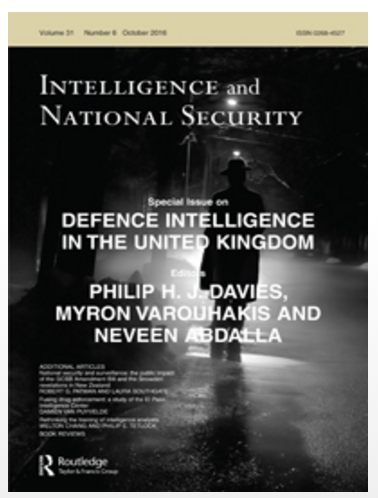
Constructing Cassandra was reviewed in the Intelligence and National Security, regarded as the world’s leading scholarly journal focused on the role of intelligence and military affairs in international relations.
You can retrieve the review here.
Our new Forbes piece is a take on W. Edwards Deming’s words: “Without data you’re just a person with an opinion.” In fact, in a big data world, it might just be the opposite: without an opinion, you’re just a person with data. Read it here.
On March 21, Milo will offer an IE Masterclass on “Geopolitics for Business” in Tokyo. The following day, he will be speaking on the same topic at Nissan’s Global Headquarters and in a Nikkei Open Seminar. Please contact him if you would like to attend one of these sessions.
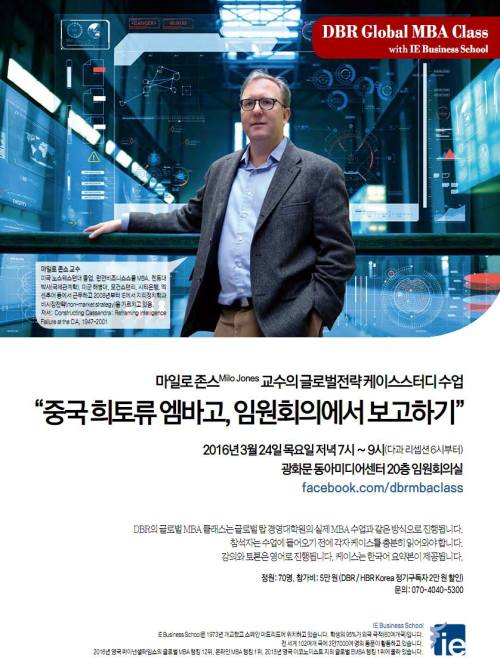
Special Lecture with Harvard Business Review Korea, 24 March, 2016
In Seoul on March 24, Milo will offer a session on the promise and pitfalls of Big Data at Ernst & Young. That session will be followed in the evening by a special, two-part Masterclass for Harvard Business Review Korea (Donga Business Review) entitled “Intelligence Tools for the Business Professional”. In this session, Milo will explore how businesses can use analytic tools drawn from the Intelligence Community to understand incidents like the de facto 2010 Chinese embargo on the export of rare earth elements. Please note that this event hosted by DBR on a fee basis; if you are interested in attending, please register here.
The content of all of these sessions will be covered in much greater depth in Madrid in June, when Milo is co-teaching the three-day IE Executive Education course “Unconventional Edges in Finance: Tools from Intelligence Agencies, Behavioral Finance, and Scenario Strategy.” Details about the course and how to register for it can be found here.
Posted in Event, Methodology & Tools, Our work featured
Tagged Big data, geopolitical alpha, Geopolitics, Intelligence Analysis
Brasidas & GeopoliticalAlpha (GpA) will hold the first of their 2016 Strategic Seminar Series on the theme “Iran – spotting and vetting opportunities” on January 26th in Zurich. Milo Jones will talk about how to use intelligence analysis tools and concepts to evaluate new strategic investment opportunities in Iran. Further information is available here.
Posted in Event
Tagged Conference, Intelligence tools, investing, Iran, Milo Jones, opportunities, seminar, Zurich
 On Wednesday, December 9, Milo is speaking on the panel “Qatar’s Strategy in a Changing World” at the Euromoney Qatar conference. The panel will address Qatar’s place among the shifting geopolitics of the Persian Gulf region, and the financial risks and opportunities generated by recent global trends. In addition to his panel, conference speakers includes senior figures from the Qatari financial and political establishment and a keynote address by Sir John Scarlett, Former Chief of MI6.
For details of the event or if you would like to attend Milo’s panel, please contact him directly (or of course contact Euromoney directly to attend the Conference as a whole).


 Silberzahn & Jones