Author Archives: Milo Jones

Geopolitics and Investing: A Reading List

As I explain to my students at IE, the most any business school can hope to do is move you from unconscious ignorance to conscious ignorance of a subject.  In other words, a course can lay a firm foundation in a subject, and then provide a jumping off point for future self-study.  After my MIAF course “Geopolitics and Investing”, that usually prompts the question, “Where should I begin such self-study?”  How do I start to learn to generate “geopolitical alpha”?

As I said in an earlier post, there are certain key books that point you towards how to think like an intelligence analyst.  Because the skills of an intelligence analyst and a geopolitical investor overlap so much, I would also say that investors interested in geopolitics start with those key books.  In particular, if you haven’t mastered the critical thinking and the basic analytic  techniques described in Thinking in Time, Essence of Decision and The Thinker’s Toolkit, you are still in kindergarten as far as intelligence analysis is concerned.    Heuer’s Psychology of Intelligence Analysis (downloadable free from the CIA’s site here) is also immensely valuable.  None of these books will teach you geopolitical analysis per se, but they will give you a solid foundation in non-quantitative analysis.
One investor gets a grip on Geopolitics
Continue reading

Soft Power, Cowering Embassies and Roman Forts

Joseph Nye, an eminent political scientist at Harvard, wrote a book about “soft power” a few years ago.  He followed that volume up by devoting a chapter to the concept in last year’s book The Future of Power.  So what is “soft power”?

According to Nye, whereas “hard power” grows out of a country’s military or economic might, soft power, “Arises from the attractiveness of a country’s culture, political ideals, and policies.”  In the Future of Power Nye examines what it means to be powerful in the twenty-first century, and how the US might set about retaining its place in the world.  He thinks soft power will be an important part of the mix, and I tend to agree.

But while I’m generally optimistic about the future of America’s place in the international order , one historical parallel related to soft power disturbs me:  the degree to which the threat of terrorism has led the US to create embassy buildings that appear to cower before contemporary threats.

Continue reading

Start with Geostrategy, or call it Tactics

Many business people seem to operate under the unconscious assumption that they’ll gain a competitive advantage through a careful daily reading of the business press.  They won’t.  The same goes for fund managers seeking to generate “alpha”:  the business press alone certainly won’t get you there.

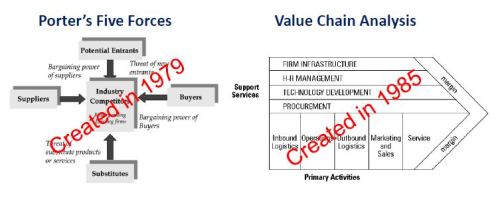
They’re also unlikely to gain a decisive edge by combining the daily parade of conventional economic data with stale “strategic” frameworks like the BCG Matrix (which dates back to 1968), Porter’s Five Forces (created in 1979), or Value Chain Analysis (introduced in 1985).   Anyone who has studied business in the last 30 years – including your competition – uses these.   They also probably read the same newspapers and buy the same economic data.   In short, the old-school “Business Strategy 101” toolkit is like a white shirt in your closet:  always safe, sometimes useful, but not a decisive business edge.   Face it:  apart from their other limitations (see below), these old strategy models are fully depreciated.  How is the unconsidered imitation of commonplace ideas “strategic”?

Fully Depreciated Thinking

There is no clearer path towards creating a strategically autistic culture or organization than by mistaking the very definition of strategy.  That’s why to gain a competitive advantage in today’s world, you have to do more.  In my view, that “more” starts by gaining an understanding of what actually constitutes business strategy, i.e. understanding the deep, structural forces that bear on the long-term success of firms, and how these forces can be engaged and harnessed.  In the classes that I teach at IE, I argue that these deep forces are geopolitical.  The metaphor that I use to explain my approach is that geopolitics shapes the climate of business, whereas the daily news and conventional economics – even macroeconomics – simply address the weather of business.

Continue reading

The Fragility of the Future (and Your Strategy)

Today I was reminded of the perils of forecasting while reviewing  a Department of Defense document, the Joint Operating Environment 2010.

“JOE 2010” as it’s called, is designed to provide the various branches of the US Armed Forces a joint perspective on likely global trends, possible shocks and their future operating environment.  If you’re interested in geopolitics and strategy, I recommend that you take a look.

Apart from its inherent interest, JOE 2010 opens with a defense planning timeline that business and financial strategy practitioners – and anyone who consumes their work  – would do well to bear in mind.  I have reproduced it verbatim here:

1900 If you are a strategic analyst for the world’s leading power, you are British, looking warily at Britain’s Age-old enemy, France.

1910 You are now allied with France, and the enemy is now Germany.

Continue reading

Gresham’s Law of Strategy: Why Bad Advice Drives out Good Advice

Near the end of a seminal essay on strategic surprise, Richard Betts writes, “The intelligence officer may perform most usefully by not offering the answers sought by authorities, but by offering questions, acting as a Socratic agnostic, nagging decision makers into awareness of the full range of uncertainty, and making authorities’ calculations harder rather than easier.”  I believe that the same should be true for corporate strategy consultants:  often their job is to make long-range calculations harder rather than easier.

Why then, is the opposite so often true?  In a world in which surprise, disruption and the unanticipated are rife, why do strategists who promise to make calculations easier rather than harder often succeed?  I think a phenomenon that I call of “Gresham’s Law of Strategic Advice” is at work.

E pluribus unum

Continue reading

Four Tools for Managing Oneself – Staying on the High Wire

One of the things that I enjoy most about the summer break is a chance to reflect upon my goals, and how I’m doing on my path to achieving them.   Though sometimes mistaken for its superficial relative “self-help” literature (beset by fads and pop-psychology), the systematic study of self-management is important for any professional.  In fact, I wish I’d paid more attention to the topic during my MBA.  Anyway, in pursuit of both summer self-reflection and preparing to teach in the autumn, I thought I’d offer my four favourite tools for managing oneself.

Continue reading

Three Videos on Forecasting and Strategic Surprise

Many people are either beginning their  holidays or are already in the midst of them.  If you’re the type of person who  reads a blog like this, you probably already know what you’re hoping to read on your break.

Therefore, I thought I’d try a different approach and offer a summer watching list rather than summer reading list.  This list recommends three videos that you might consider for your travels or during your “down time”.   All address different aspects forecasting, uncertainty, strategic surprises and decision-making.  When you feel like a break from reading, give them a try.

Continue reading

Business and Intelligence Techniques: the Role of Competing Hypotheses

I get a lot of requests to discuss further the application of intelligence analysis to business, so today I’ll discuss the uses and limitations of a common analytic technique.

One tool that I teach at IE is the Analysis of Competing Hypotheses (ACH).  ACH is an analytic tool originally developed by Richards J. Heuer at the CIA, but it is remarkably useful in business as well.  ACH uses a deceptively simple framework to use ideas from the scientific method, cognitive psychology and decision analysis to overcome a common but immensely important bias:  the fact that we tend to perceive what we expect to perceive rather than what actually exists.  To illustrate this tendency, read the words in the three triangles below:

If you’re like most people, the phrases “written” in the triangles are familiar.  To find out what’s actually written in each triangle, refer to the bottom of this entry (or try the old proof-readers trick of reading them backwards).

Continue reading

China’s Present, the World’s Future, and the Pretense of Knowledge

Last Tuesday I attended the Economist’s Bellwether Europe conference in London.  Several speakers raised ideas that made me want to follow up Philippe’s latest piece “Has China Peaked?”.

At the conference, many speakers and panelist (from regulators like the FSA’s Martin Wheatley, to economists like Roubini’s Arnab Das, to portfolio managers like Blackrock’s Richard Kushel) linked the future stability of the Eurozone and the prosperity of America to the continued growth of China.  Niall Ferguson was even more explicit, saying at one point that “The governor of the PBOC has far more control over the future of the US and European economies than either Ben Bernanke or Jean-Claude Trichet”.  I tend to agree that US and EU economic stability is tied to Chinese growth, but am worried by that fact,  and skeptical about Chinese “control” of their economy either through their Central Bank or through “administrative measures”.

The People's Bank

The image evoked by statements such as Ferguson’s (even though I am sure he is too smart to have intended it) is of a carefully calculating Zhou Xiachuan sitting behind a desk in Beijing pressing buttons and pulling levers – a man in commanding a linear, essentially Newtonian system.  The same tends to happen when people talk about the powers and actions of the Fed and the ECB.  Even so-called “centrally planned” economies don’t work like that.  Economies are not not machines, and they are not linear in the sense that once the behavior of its component pieces are understood individually, one simply needs to add them up to predict – and control via a Central Bank or other bureaucracy – the behavior of the whole.

A point which is not original but which bears repeating because it is so often forgotten is that Economics is not Physics, it’s a “Social Science” (a false metaphor if there ever was one).  As one scholar says “God gave Physics the easy problems” and the behavior of economies is non-linear rather than additive.

Continue reading

Crossing the Hudson to Spit: Moore’s Law, Steam Engines and Genetic Technology

One of the features of our age is the idea that business suffers from a unique level of technological disruption, an attitude that I call  Techno-Egotism.  Businesspeople are told routinely that they operate in an era of “unprecedented” technological change; as a result, they feel very Modern (and rather sorry for themselves).  They also, however, end up lacking perspective, and that can be a strategic liability.

I believe that if posterity registers our age’s Techno-Egotism at all, they will find it rather quaint.  This thought struck me with great force last week as I drove across the George Washington Bridge, from New York to New Jersey, specifically in order to spit legally into a tube, and then mail that tube.

Continue reading