Category Archives: Theory

Making strategic decisions under uncertainty: The case for non-predictive strategy

The goal of strategy is to decide what to do in a given situation to achieve a given objective.  Basically, strategic decisions comes down to the question “what to do next?”. In environments characterized by uncertainty (defined as objective lack of information), this is no simple question, and several approaches are possible to address it.  Two dimensions characterize these possible approaches: prediction and control.

Prediction asks  to what extent does my approach rely on a forecast of the future environment. Strong prediction corresponds to either a planning-type approach – I create a detailed prediction of the future before initiating action – or a vision type:  I imagine the future and I strive to make this vision a reality.  Low prediction corresponds to a more adaptive approach:  I do not try to predict the future environment, but instead I move on and I adapt to changes along the way.
Control asks how I can control the evolution of my environment.  The over-arching assumption of classic strategy is that the firm has little influence on its environment, which is for the most part given (or “exogenous”).  All a firm can do is to find a place in this environment (planning /positioning) or adapt when it changes (adaptation).  Hence the importance of the notion of “fit” that the field insists upon (e.g. Michael Porter in 1996).  On the opposite side of the spectrum, the field of entrepreneurship observes that a firm can change its environment in profound ways, sometimes from an ex ante defined vision, or through the logic of future-agnostic gradual transformation of the environment.  There are many examples of entrepreneurs starting with odds apparently stacked against them and completely transforming their environments:  Michael Dell, Richard Branson, Sam Walton, to name just a few.
Continue reading

Start with Geostrategy, or call it Tactics

Many business people seem to operate under the unconscious assumption that they’ll gain a competitive advantage through a careful daily reading of the business press.  They won’t.  The same goes for fund managers seeking to generate “alpha”:  the business press alone certainly won’t get you there.

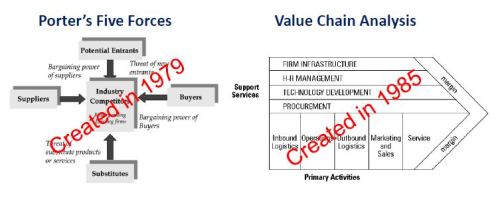
They’re also unlikely to gain a decisive edge by combining the daily parade of conventional economic data with stale “strategic” frameworks like the BCG Matrix (which dates back to 1968), Porter’s Five Forces (created in 1979), or Value Chain Analysis (introduced in 1985).   Anyone who has studied business in the last 30 years – including your competition – uses these.   They also probably read the same newspapers and buy the same economic data.   In short, the old-school “Business Strategy 101” toolkit is like a white shirt in your closet:  always safe, sometimes useful, but not a decisive business edge.   Face it:  apart from their other limitations (see below), these old strategy models are fully depreciated.  How is the unconsidered imitation of commonplace ideas “strategic”?

Fully Depreciated Thinking

There is no clearer path towards creating a strategically autistic culture or organization than by mistaking the very definition of strategy.  That’s why to gain a competitive advantage in today’s world, you have to do more.  In my view, that “more” starts by gaining an understanding of what actually constitutes business strategy, i.e. understanding the deep, structural forces that bear on the long-term success of firms, and how these forces can be engaged and harnessed.  In the classes that I teach at IE, I argue that these deep forces are geopolitical.  The metaphor that I use to explain my approach is that geopolitics shapes the climate of business, whereas the daily news and conventional economics – even macroeconomics – simply address the weather of business.

Continue reading

Welcome to Extremistan! Why some things cannot be predicted and what that means for your strategy

In an earlier post about forecasting, I mentioned the work by Nassim Taleb on the concept of black swan. In his remarkable book, “The Black Swan”, Taleb describes at length the characteristics of environments that can be subject to black swans (unforeseeable, high-impact events).

When we make a forecast, we usually explicitly or implicitly base it on an assumption of continuity in a statistical series. For example, a company building its sales forecast for next year considers past sales, estimates a trend based on these sales, makes some adjustments based on current circumstances and then generates a sales forecast.  The hypothesis (or rather assumption, as it is rarely explicit) in this process is that each additional year is not fundamentally different from the previous years. In other words, the distribution of possible values for next year’s sales is Gaussian (or “normal”): the probability that sales are the same is very high; the probability of an extreme variation (doubling or dropping to zero) is very low. In fact, the higher the envisaged variation, the lower the probability that such variation will occur.  As a result, it is reasonable to discard extreme values in the forecasts:  no marketing director is working on an assumption of sales dropping to zero.

Continue reading

The Fragility of the Future (and Your Strategy)

Today I was reminded of the perils of forecasting while reviewing  a Department of Defense document, the Joint Operating Environment 2010.

“JOE 2010” as it’s called, is designed to provide the various branches of the US Armed Forces a joint perspective on likely global trends, possible shocks and their future operating environment.  If you’re interested in geopolitics and strategy, I recommend that you take a look.

Apart from its inherent interest, JOE 2010 opens with a defense planning timeline that business and financial strategy practitioners – and anyone who consumes their work  – would do well to bear in mind.  I have reproduced it verbatim here:

1900 If you are a strategic analyst for the world’s leading power, you are British, looking warily at Britain’s Age-old enemy, France.

1910 You are now allied with France, and the enemy is now Germany.

Continue reading

Gresham’s Law of Strategy: Why Bad Advice Drives out Good Advice

Near the end of a seminal essay on strategic surprise, Richard Betts writes, “The intelligence officer may perform most usefully by not offering the answers sought by authorities, but by offering questions, acting as a Socratic agnostic, nagging decision makers into awareness of the full range of uncertainty, and making authorities’ calculations harder rather than easier.”  I believe that the same should be true for corporate strategy consultants:  often their job is to make long-range calculations harder rather than easier.

Why then, is the opposite so often true?  In a world in which surprise, disruption and the unanticipated are rife, why do strategists who promise to make calculations easier rather than harder often succeed?  I think a phenomenon that I call of “Gresham’s Law of Strategic Advice” is at work.

E pluribus unum

Continue reading

Three Videos on Forecasting and Strategic Surprise

Many people are either beginning their  holidays or are already in the midst of them.  If you’re the type of person who  reads a blog like this, you probably already know what you’re hoping to read on your break.

Therefore, I thought I’d try a different approach and offer a summer watching list rather than summer reading list.  This list recommends three videos that you might consider for your travels or during your “down time”.   All address different aspects forecasting, uncertainty, strategic surprises and decision-making.  When you feel like a break from reading, give them a try.

Continue reading

Business and Intelligence Techniques: the Role of Competing Hypotheses

I get a lot of requests to discuss further the application of intelligence analysis to business, so today I’ll discuss the uses and limitations of a common analytic technique.

One tool that I teach at IE is the Analysis of Competing Hypotheses (ACH).  ACH is an analytic tool originally developed by Richards J. Heuer at the CIA, but it is remarkably useful in business as well.  ACH uses a deceptively simple framework to use ideas from the scientific method, cognitive psychology and decision analysis to overcome a common but immensely important bias:  the fact that we tend to perceive what we expect to perceive rather than what actually exists.  To illustrate this tendency, read the words in the three triangles below:

If you’re like most people, the phrases “written” in the triangles are familiar.  To find out what’s actually written in each triangle, refer to the bottom of this entry (or try the old proof-readers trick of reading them backwards).

Continue reading

We have met the enemy and he is, er, forecasting

There is no doubt we are terribly bad at forecasting. Even the smartest among us are. Even the best and the brightest, whom we have tasked to save the world from financial annihilation, are.  Take Ben Bernanke, Chairman of the Federal Reserve. In 2004, he declared, in a speech ominously titled “The Great Moderation”: “One of the most striking features of the economic landscape over the past twenty years or so has been a substantial decline in macroeconomic volatility. This […] makes me optimistic for the future.” You might want to read the full transcript of the “Great Moderation” talk here because it is for a fascinating reading on how wrong experts can be at forecasting. And it’s not just Ben. In fact, political, economic and business histories are littered by forecasts and predictions that turned out to be ridiculously wrong. From the commercial potential of the Xerox machine or of Nespresso, from the possibility of heavier than air flight to the market for mobile phones, from prosperity at the corner of the street to Japan as number One. Our hopelessness at forecasting is a confirmed fact.

Continue reading

Five ways to use history well

I have discussed the topic of the use of history for decision makers in a previous post about Richard Neustadt and Ernest May‘s analog framework. Historian Francis Gavin gave a very interesting speech for the Longnow foundation on the same question, but from a different angle. Gavin lays out five key concepts which, if properly understood and employed, should provide a firmer grasp on how historical analysis can be of benefit to decision makers.   I would also argue that they can benefit not just the policymakers but also the public at large.  These concepts are vertical history, horizontal history, chronological proportionality, unintended consequences and policy insignificance.

Continue reading

China’s Present, the World’s Future, and the Pretense of Knowledge

Last Tuesday I attended the Economist’s Bellwether Europe conference in London.  Several speakers raised ideas that made me want to follow up Philippe’s latest piece “Has China Peaked?”.

At the conference, many speakers and panelist (from regulators like the FSA’s Martin Wheatley, to economists like Roubini’s Arnab Das, to portfolio managers like Blackrock’s Richard Kushel) linked the future stability of the Eurozone and the prosperity of America to the continued growth of China.  Niall Ferguson was even more explicit, saying at one point that “The governor of the PBOC has far more control over the future of the US and European economies than either Ben Bernanke or Jean-Claude Trichet”.  I tend to agree that US and EU economic stability is tied to Chinese growth, but am worried by that fact,  and skeptical about Chinese “control” of their economy either through their Central Bank or through “administrative measures”.

The People's Bank

The image evoked by statements such as Ferguson’s (even though I am sure he is too smart to have intended it) is of a carefully calculating Zhou Xiachuan sitting behind a desk in Beijing pressing buttons and pulling levers – a man in commanding a linear, essentially Newtonian system.  The same tends to happen when people talk about the powers and actions of the Fed and the ECB.  Even so-called “centrally planned” economies don’t work like that.  Economies are not not machines, and they are not linear in the sense that once the behavior of its component pieces are understood individually, one simply needs to add them up to predict – and control via a Central Bank or other bureaucracy – the behavior of the whole.

A point which is not original but which bears repeating because it is so often forgotten is that Economics is not Physics, it’s a “Social Science” (a false metaphor if there ever was one).  As one scholar says “God gave Physics the easy problems” and the behavior of economies is non-linear rather than additive.

Continue reading