
Soft Power, Cowering Embassies and Roman Forts

Joseph Nye, an eminent political scientist at Harvard, wrote a book about “soft power” a few years ago.  He followed that volume up by devoting a chapter to the concept in last year’s book The Future of Power.  So what is “soft power”?

According to Nye, whereas “hard power” grows out of a country’s military or economic might, soft power, “Arises from the attractiveness of a country’s culture, political ideals, and policies.”  In the Future of Power Nye examines what it means to be powerful in the twenty-first century, and how the US might set about retaining its place in the world.  He thinks soft power will be an important part of the mix, and I tend to agree.

But while I’m generally optimistic about the future of America’s place in the international order , one historical parallel related to soft power disturbs me:  the degree to which the threat of terrorism has led the US to create embassy buildings that appear to cower before contemporary threats.

Continue reading

Competitive intelligence and strategic surprises: Why monitoring weak signals is not the right approach

The difficulty of anticipating strategic surprises is often ascribed to a ‘signal-to-noise’ problem, i.e. to the inability to pick up so-called ‘weak signals’ that foretell such surprises.  In fact, monitoring of weak signals has become a staple of competitive intelligence.  This is all the more so since the development of information technology that allows the accumulation and quasi-automatic processing of massive amount of data.  The idea is that the identification of weak signals will enable an organization to detect a problem (or an opportunity) early and, hence, to react more quickly and more appropriately.  For instance, a firm can detect a change in attitude of consumer behavior by spending time with the most advanced of them, as Nokia did in the early 1990s, a move that enabled the firm to realize that the mobile phone was becoming a fashion item.

Continue reading

Managing the unexpected – On the work of Karl E. Weick and Kathleen M. Sutcliffe

Karl Weick has long been known for his work on organization theory.  In particular, his work focuses on how organizations make sense of complex and uncertain environments.  Among Weick’s most famous works is the study of the fire in Mann Gulch, an initially banal forest fire in 1949 that went wrong and resulted in the deaths of 13 firefighters. Weick’s analysis shows that in such conditions,  a professional team faces what he calls a ‘cosmological event’, ie an event so unexpected and powerful that it destroys the will and the ability of the victims to act, in particular to act as a group.  It is a great piece of scholarship.

“Managing the Unexpected” explores how the organization can handle the unexpected.  To do so, Weick and Sutcliffe chose to study organizations that are specifically created with that end in mind, which they call High-Reliability Organizations (HRO):  firefighters, crew of a submarine, the control center of a nuclear plant, etc. What principles do these organizations implement to operate?

Continue reading

Conference on strategic surprises at the CIA

On Wednesday, January 18th, I will be giving a conference on the topic of strategic surprise at EMLYON Business School, as part of the series “The Art of Management”.  In this context, a strategic surprise is defined as the sudden realization by an organization that it has operated on the basis of an erroneous threat assessment resulting in an inability to anticipate a serious threat to its vital interests.

While the majority of the research explains strategic surprises (such as September 11) with psychological, bureaucratic or cybernetic (absence of detection of weak signals for example) models, an in-depth research on more than 50 years of the CIA’s history shows that the origin of strategic surprises often lies with the characteristics of identity and culture of the organization.  This research was started by Milo a few years ago, and we now pursue it together.  We show how the CIA was the victim of several strategic surprises, and that these surprises are largely explained by the social construction of the organization: whom it recruits, how it trains agents and analysts, how it develops its culture, etc.  In essence, what an organization is surprised by depends on its identity. After presenting the finding about the CIA, we will discuss what lessons can be drawn from these results for businesses, particularly in the field of innovation and strategy.  We will make the case that here too, the difficulties are often cultural, and results can be improved using this mode of analysis.

If you are interested in the conference, please contact us.

Making strategic decisions under uncertainty: The case for non-predictive strategy

The goal of strategy is to decide what to do in a given situation to achieve a given objective.  Basically, strategic decisions comes down to the question “what to do next?”. In environments characterized by uncertainty (defined as objective lack of information), this is no simple question, and several approaches are possible to address it.  Two dimensions characterize these possible approaches: prediction and control.

Prediction asks  to what extent does my approach rely on a forecast of the future environment. Strong prediction corresponds to either a planning-type approach – I create a detailed prediction of the future before initiating action – or a vision type:  I imagine the future and I strive to make this vision a reality.  Low prediction corresponds to a more adaptive approach:  I do not try to predict the future environment, but instead I move on and I adapt to changes along the way.
Control asks how I can control the evolution of my environment.  The over-arching assumption of classic strategy is that the firm has little influence on its environment, which is for the most part given (or “exogenous”).  All a firm can do is to find a place in this environment (planning /positioning) or adapt when it changes (adaptation).  Hence the importance of the notion of “fit” that the field insists upon (e.g. Michael Porter in 1996).  On the opposite side of the spectrum, the field of entrepreneurship observes that a firm can change its environment in profound ways, sometimes from an ex ante defined vision, or through the logic of future-agnostic gradual transformation of the environment.  There are many examples of entrepreneurs starting with odds apparently stacked against them and completely transforming their environments:  Michael Dell, Richard Branson, Sam Walton, to name just a few.

Continue reading

Start with Geostrategy, or call it Tactics

Many business people seem to operate under the unconscious assumption that they’ll gain a competitive advantage through a careful daily reading of the business press.  They won’t.  The same goes for fund managers seeking to generate “alpha”:  the business press alone certainly won’t get you there.

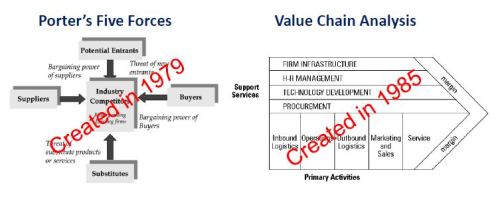
They’re also unlikely to gain a decisive edge by combining the daily parade of conventional economic data with stale “strategic” frameworks like the BCG Matrix (which dates back to 1968), Porter’s Five Forces (created in 1979), or Value Chain Analysis (introduced in 1985).   Anyone who has studied business in the last 30 years – including your competition – uses these.   They also probably read the same newspapers and buy the same economic data.   In short, the old-school “Business Strategy 101” toolkit is like a white shirt in your closet:  always safe, sometimes useful, but not a decisive business edge.   Face it:  apart from their other limitations (see below), these old strategy models are fully depreciated.  How is the unconsidered imitation of commonplace ideas “strategic”?

Fully Depreciated Thinking

There is no clearer path towards creating a strategically autistic culture or organization than by mistaking the very definition of strategy.  That’s why to gain a competitive advantage in today’s world, you have to do more.  In my view, that “more” starts by gaining an understanding of what actually constitutes business strategy, i.e. understanding the deep, structural forces that bear on the long-term success of firms, and how these forces can be engaged and harnessed.  In the classes that I teach at IE, I argue that these deep forces are geopolitical.  The metaphor that I use to explain my approach is that geopolitics shapes the climate of business, whereas the daily news and conventional economics – even macroeconomics – simply address the weather of business.

Continue reading

Welcome to Extremistan! Why some things cannot be predicted and what that means for your strategy

In an earlier post about forecasting, I mentioned the work by Nassim Taleb on the concept of black swan. In his remarkable book, “The Black Swan”, Taleb describes at length the characteristics of environments that can be subject to black swans (unforeseeable, high-impact events).

When we make a forecast, we usually explicitly or implicitly base it on an assumption of continuity in a statistical series. For example, a company building its sales forecast for next year considers past sales, estimates a trend based on these sales, makes some adjustments based on current circumstances and then generates a sales forecast.  The hypothesis (or rather assumption, as it is rarely explicit) in this process is that each additional year is not fundamentally different from the previous years. In other words, the distribution of possible values for next year’s sales is Gaussian (or “normal”): the probability that sales are the same is very high; the probability of an extreme variation (doubling or dropping to zero) is very low. In fact, the higher the envisaged variation, the lower the probability that such variation will occur.  As a result, it is reasonable to discard extreme values in the forecasts:  no marketing director is working on an assumption of sales dropping to zero.

Continue reading

The Fragility of the Future (and Your Strategy)

Today I was reminded of the perils of forecasting while reviewing  a Department of Defense document, the Joint Operating Environment 2010.

“JOE 2010” as it’s called, is designed to provide the various branches of the US Armed Forces a joint perspective on likely global trends, possible shocks and their future operating environment.  If you’re interested in geopolitics and strategy, I recommend that you take a look.

Apart from its inherent interest, JOE 2010 opens with a defense planning timeline that business and financial strategy practitioners – and anyone who consumes their work  – would do well to bear in mind.  I have reproduced it verbatim here:

1900 If you are a strategic analyst for the world’s leading power, you are British, looking warily at Britain’s Age-old enemy, France.

1910 You are now allied with France, and the enemy is now Germany.

Continue reading

Gresham’s Law of Strategy: Why Bad Advice Drives out Good Advice

Near the end of a seminal essay on strategic surprise, Richard Betts writes, “The intelligence officer may perform most usefully by not offering the answers sought by authorities, but by offering questions, acting as a Socratic agnostic, nagging decision makers into awareness of the full range of uncertainty, and making authorities’ calculations harder rather than easier.”  I believe that the same should be true for corporate strategy consultants:  often their job is to make long-range calculations harder rather than easier.

Why then, is the opposite so often true?  In a world in which surprise, disruption and the unanticipated are rife, why do strategists who promise to make calculations easier rather than harder often succeed?  I think a phenomenon that I call of “Gresham’s Law of Strategic Advice” is at work.

E pluribus unum

Continue reading

Why theory matters. Even to business and yes, even to you as well

It’s become commonplace to hear, including from my fellow academic colleagues, that we academics write articles in journals that nobody reads. Students and participants in executive programs, we are often told, want practical tools that they can apply immediately in their job, and they have no patience for theory. It often goes to the point where we are asked not so much to teach as to get participants to talk about their favorite topic, ie themselves, and lead a class discussion on this anecdotal basis supported by some multimedia slides while students are transfixed by their twitter account. Some schools have even acknowledged this and claim that they don’t teach, but develop what’s already inside participants. Put otherwise, bring your own food: we repackage what you know already and you pick up the bill. The idea that we as teachers may, at some point, introduce some theoretical content increasingly seems suspect and the sure sign of out of touch academia trying to influence a world they are said not to understand. What do eggheads know about business? The idea of teaching, that we could impart some knowledge, but also exert our professional judgment on what we should teach to whom seems preposterous and a sure sign of academic arrogance. I disagree. I teach, and I make no apologies for it.

Continue reading